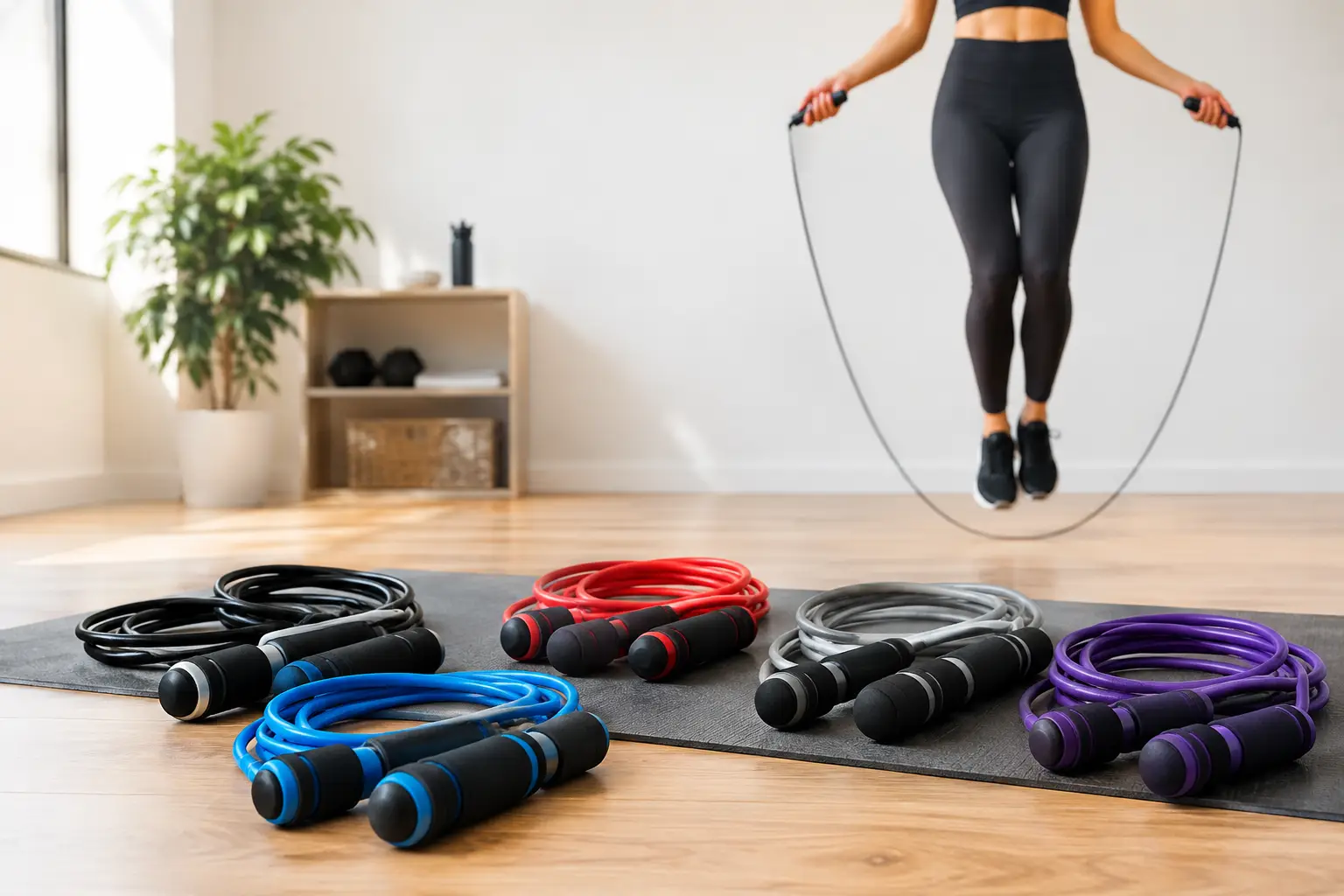
A weighted jump rope can make a short home workout feel surprisingly complete. Ten focused minutes can challenge your calves, shoulders, grip, coordination, and cardiovascular system without taking over your spare bedroom or garage. The best weighted jump ropes make that work feel controlled, not clumsy, which is why rope weight, handle comfort, and available floor space matter more than flashy features.
Weighted ropes are not automatically better than standard speed ropes. They are a different tool. A light rope helps you move quickly and practice footwork; a heavier rope creates more feedback and resistance with every turn. For many home exercisers, that added feedback makes it easier to find a rhythm, while the resistance adds intensity without needing a treadmill, bike, or large piece of equipment.
Affiliate disclosure: As an Amazon Associate, HealthGearSpot earns from qualifying purchases. If you buy through a link on this site, your purchase is made on Amazon. The product links below go to HealthGearSpot catalog pages, which link onward to Amazon, where you should confirm the current price, size, and availability before buying.
The 6 Best Weighted Jump Ropes at a Glance
| Rope | Verified weight and key specs | Best for |
|---|---|---|
| MOGOLD interchangeable set | 1/5 lb, 1/4 lb, and 1/2 lb ropes; length adjustable; leather grip; 360-degree spin | Overall: one system that grows with you |
| WILLGOO HEREROPE 1/4 lb | 1/4 lb; ball-bearing; ergonomic grip; tangle-free cable | Beginners and fast cardio |
| HANDIO 1/2 lb | 1/2 lb; 8-10 ft adjustable length; steel rope; ball bearings; metal handles | Boxing and cardio intervals |
| nonogo 1.1 lb | 1.1 lb; adjustable; 10 mm heavy PVC | High-intensity training |
| Proud Panda 1 lb silicone-grip | 1 lb; adjustable length; silicone comfortable grips | Everyday cardio with a comfortable grip |
| MOGOLD pre-sized 1 lb | 1 lb; pre-sized M 8.4 ft, L 9 ft, XL 9.6 ft; faux leather handle; no adjustment needed | A no-fuss, ready-to-use fit |
The Best Weighted Jump Ropes in Detail
1. MOGOLD Interchangeable Weighted Jump Rope Set - Best overall
Best for: home exercisers who want one handle set that can progress from lighter technique work to heavier conditioning.
- Interchangeable 1/5 lb, 1/4 lb, and 1/2 lb ropes
- Length adjustable, with a leather grip and 360-degree spin
Limitation: it costs more upfront than a single rope, and you have to swap ropes to change the weight.
2. WILLGOO HEREROPE 1/4 lb Weighted Jump Rope - Best for beginners and fast cardio
Best for: beginners moving up from a speed rope, and anyone who wants a light weighted rope for faster cardio sessions.
A note on the name: the catalog and Amazon listing brand is WILLGOO, and HEREROPE is the rope line shown on the manufacturer's own site, hererope.com.
- 1/4 lb weight
- Ball-bearing spin, ergonomic grip, and tangle-free cable
Limitation: at 1/4 lb it is a light rope, so it will not give you the heavy resistance needed for serious conditioning work.
3. HANDIO 1/2 lb Weighted Jump Rope - Best for boxing and cardio intervals
Best for: boxing-style and CrossFit-style cardio intervals where a mid-weight rope with a firm, durable feel suits the workout.
- 1/2 lb weight
- 8-10 ft adjustable length, steel rope, ball bearings, and metal handles
Limitation: the steel cable and metal handles feel firm rather than cushioned, so check the grip feel and use a mat on rough floors.
4. nonogo 1.1 lb Weighted Jump Rope - Best for high-intensity training
Best for: high-intensity training, MMA, boxing, and CrossFit-style sessions where a heavier PVC rope adds clear resistance.
- 1.1 lb weight
- Adjustable, 10 mm heavy PVC rope
Limitation: at 1.1 lb it is a big step up from a light rope, so build up gradually rather than starting with long sessions.
5. Proud Panda 1 lb Silicone-Grip Weighted Jump Rope - Best for everyday cardio
Best for: everyday cardio, boxing, and endurance training where a comfortable silicone grip matters.
- 1 lb weight
- Adjustable length and silicone comfortable grips
Limitation: the weight is fixed at 1 lb, so you will need a different rope if you later want a much lighter or heavier option.
6. MOGOLD Pre-Sized 1 lb Weighted Jump Rope - Best for a no-fuss fit
Best for: anyone who wants to skip length adjustment and start jumping with a ready-sized rope.
- 1 lb weight
- Three pre-sized lengths: M 8.4 ft, L 9 ft, XL 9.6 ft; no adjustment needed
- Ergonomic faux leather handle
Limitation: you must pick the right size up front, because a pre-sized rope cannot be shortened later.
What Makes the Best Weighted Jump Ropes Worth Buying?
The right rope should match your current conditioning, not the workout you imagine doing six months from now. A rope that is too heavy can pull you out of position, encourage shoulder shrugging, and turn a useful cardio session into a frustrating tangle. A rope that is too light may not give you the resistance you wanted in the first place.
For most beginners, a rope in the light-to-moderate weighted range is the practical starting point. Look for a rope that has enough substance to feel as it turns but does not force you to use your arms like you are swinging a sledgehammer. A thicker PVC rope or a lightly weighted braided rope often fits this role well.
Experienced jumpers, former athletes, and people using ropes for conditioning intervals can benefit from heavier options. These models create more demand through the forearms, shoulders, upper back, and core. The trade-off is speed. Heavy ropes are not built for fast double-unders or long, relaxed sessions. They are better for shorter rounds, such as 20 to 60 seconds of work followed by recovery.
Handle design is equally important. Smooth, narrow handles may suit a fast rope, but weighted-rope training usually feels better with longer handles and a secure grip. Foam can be comfortable, especially if you are new to the movement, while textured rubber typically holds up better when hands get sweaty. If you have smaller hands, avoid extra-wide handles that make it hard to keep your wrists relaxed.
Finally, measure your workout area before shopping. You need more than enough room to stand. Leave clearance in front, behind, and above you for the rope's full arc. A low basement ceiling, ceiling fan, or rough concrete patio can quickly limit your choices. For indoor use, a flat exercise mat or jump-rope mat protects both the rope and your flooring while reducing some impact noise.
Best Weighted Jump Ropes by Home Training Need
Rather than choosing one rope as the winner for everyone, compare weighted jump ropes by the way you plan to train. The best purchase is the one you will actually pick up several times a week.
Best overall: An interchangeable weighted rope system
An interchangeable system is a smart choice if you want one compact tool that can grow with you. These setups pair one handle set with multiple ropes, usually progressing from a lighter conditioning rope to heavier resistance options. You can start with the lightest rope for technique, then move up when your shoulders and timing are ready.
This style costs more upfront than a single rope, but it can replace several individual purchases. It also works well for shared home gyms because two people with different fitness levels can use the same handle system with different rope weights. Check whether replacement ropes are sold separately and whether the handles use a secure, easy-to-change connection.
Best for beginners: A lightly weighted PVC rope
A basic PVC weighted rope is often the least intimidating entry point. The rope gives you enough sensory feedback to know where it is during each turn, which can make timing easier than with a thin cable speed rope. It is also usually affordable, simple to store, and less punishing when you miss a jump.
Choose an adjustable model if possible. Rope length can make or break your first few sessions. As a general starting point, stand on the center of the rope and pull the handles upward. For many users, handles reaching roughly chest to armpit height provide a workable baseline, though your jumping style and torso length can change the ideal fit.
PVC ropes do wear down on abrasive surfaces. If you train outside on concrete, expect to replace the rope sooner or use a mat. That is not necessarily a deal-breaker, but it should factor into a budget purchase.
Best for conditioning: A heavy braided rope
If your goal is to raise your heart rate fast, a heavy braided rope delivers a different kind of workout than a standard jump rope. The rope's mass creates momentum, so each rotation demands a strong but controlled turn from the wrists, forearms, and shoulders. This makes heavy rope intervals a useful option for people who enjoy kettlebell circuits, sled work, or boxing-style conditioning.
The best heavy ropes have durable coverings, comfortable long handles, and enough flexibility to move smoothly rather than slap the ground like a rigid cable. Do not assume heavier is always better. A moderately heavy rope that lets you complete clean 30-second intervals is usually more valuable than an ultra-heavy rope that causes you to stop after five awkward jumps.
Heavy ropes also need more open space. Their wider arc can clip furniture, walls, and nearby storage racks. They are best suited to a garage gym, driveway, patio, or a dedicated open area with a mat.
Best for small spaces: A cordless weighted rope
Cordless weighted ropes use short weighted ends instead of a full-length rope. They cannot perfectly reproduce the timing and skill of traditional jumping, but they are a practical alternative for apartments, low ceilings, and rooms with delicate furniture. You can still practice the arm motion and use a light bounce or march in place without worrying about striking a lamp or ceiling fan.
This option is especially useful for low-impact cardio. Skip the jump and alternate heel raises, step-touches, or a gentle boxer shuffle while rotating the handles. People managing joint sensitivity may prefer this approach, although any new exercise plan should be adjusted around individual limitations.
Best for fast intervals: A weighted-handle speed rope
Some ropes place more of the weight in the handles while keeping the cable relatively light. This design is useful if you want quick rotations with a little more upper-body demand. It can be a good bridge between a basic speed rope and a truly heavy rope, particularly for circuit training where you want 30 to 90 seconds of continuous movement.
Pay close attention to cable durability and length adjustment. Thin cables are fast, but they can kink or wear out when used on rough flooring. This is another category where a jump-rope mat earns its place in a home gym.
How to Choose a Weighted Jump Rope Without Overspending
Start with the training problem you want the rope to solve. If you need convenient cardio after work, a light or moderate rope is likely enough. If your current workout plan already includes strength training and you want a brutal finisher, a heavier braided rope may provide more value. If space is your main obstacle, cordless is often the honest answer.
Avoid buying a large rope bundle just because it includes several weights. Multiple ropes are useful only if you will use them. A single adjustable rope with comfortable handles can support months of workouts, especially when you vary the work-to-rest ratio instead of adding more equipment.
Build up gradually when you first bring home a weighted rope. Start with five rounds of 20 seconds of jumping and 40 seconds of rest. Keep your elbows close to your sides, turn mainly from the wrists, and jump only high enough for the rope to pass underneath. As your timing improves, extend the work intervals before increasing rope weight.
You do not need a wall of cardio equipment to make your home gym effective. Pick a weighted rope that fits your floor space, feels manageable in your hands, and makes you want to take a quick movement break. That is the gear most likely to earn its spot near your mat, dumbbells, and daily routine.
Buying Checklist
- Weight first: start light to moderate if you are new, and only go heavier when you can keep clean form for short intervals.
- Length: choose an adjustable rope, or, for a pre-sized rope, confirm your size (M 8.4 ft, L 9 ft, or XL 9.6 ft for the MOGOLD pre-sized rope) before ordering.
- Handles: look for a secure, comfortable grip that suits your hand size, such as leather, faux leather, silicone, or metal, depending on the model.
- Space: measure your workout area and leave clearance in front, behind, and above you.
- Surface: use a mat on rough floors to protect the rope and your flooring, and expect faster wear on concrete.
- Growth: if two people will share the rope, or you want to progress, an interchangeable system avoids buying several separate ropes.
Frequently Asked Questions
What weight weighted jump rope should a beginner start with?
A light to moderate weight is the practical starting point. A rope around 1/4 lb to 1/2 lb gives enough feedback to feel each turn without pulling you out of position, and the 1 lb options above are a reasonable next step once your timing is steady.
How do I size a weighted jump rope?
For an adjustable rope, stand on the center of the rope and pull the handles upward; for many users, handles reaching roughly chest to armpit height provide a workable baseline. For a pre-sized rope, choose from the listed lengths instead: M 8.4 ft, L 9 ft, or XL 9.6 ft for the MOGOLD pre-sized rope in this guide.
Can I use a weighted jump rope indoors?
Yes, if you have clearance in front, behind, and above you for the rope's full arc, and a mat helps protect both the rope and your flooring. Low ceilings, ceiling fans, and nearby furniture are the usual limits.
Do I need an interchangeable rope system?
Not necessarily. A single adjustable rope can support months of workouts. An interchangeable system is most useful if you want to progress through weights, or if two people with different fitness levels will share one handle set.
How do I start with a weighted rope without overdoing it?
Build up gradually: start with five rounds of 20 seconds of jumping and 40 seconds of rest, keep your elbows close to your sides, turn mainly from the wrists, and extend the work intervals before increasing rope weight.