A stability ball that is too small can pull your knees high and limit your range of motion. One that is too large can make you feel unstable before the workout even starts. Learning how to size exercise ball correctly gives you a more comfortable setup for core work, mobility drills, strength training, and even occasional desk sitting.
The size printed on the box refers to the ball's diameter when fully inflated, not a one-size-fits-all recommendation. Your height is the best starting point, but inflation level, leg length, and the exercises you plan to do all affect the final fit.
How to Size Exercise Ball by Height
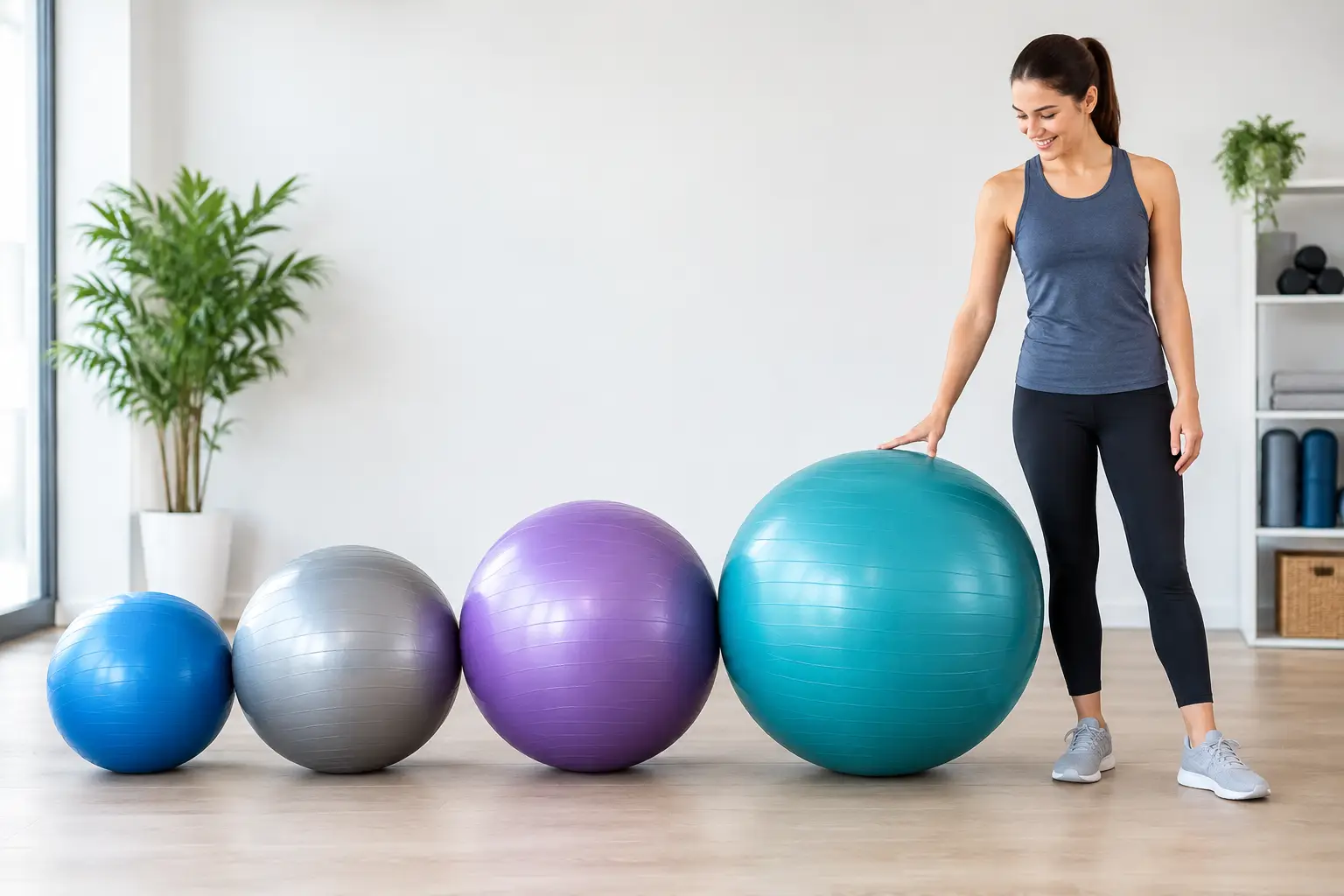
Most exercise balls come in 45 cm, 55 cm, 65 cm, and 75 cm diameters. Start with the height ranges below, then confirm your choice with a seated fit check once the ball is inflated.
| Your height | Recommended ball diameter | | --- | --- | | Under 5 ft | 45 cm | | 5 ft to 5 ft 7 in | 55 cm | | 5 ft 8 in to 6 ft 2 in | 65 cm | | 6 ft 3 in to 6 ft 8 in | 75 cm | | Over 6 ft 8 in | 85 cm, if available |
These ranges are useful, not absolute. If you have longer or shorter legs than average for your height, the seated position matters more than the chart. A person at 5 ft 7 in with long legs may be more comfortable on a 65 cm ball, while someone at 5 ft 8 in with a shorter inseam may prefer 55 cm.
When you fall directly between sizes, think about your primary use. Choose the smaller ball for floor exercises, limited ceiling clearance, or a firmer and more grounded feel. Choose the larger ball if you need it for desk work, wall squats, or exercises where a higher seated position feels better.
Use the 90-Degree Seated Test
The simplest way to confirm exercise ball sizing is to sit in the center of the fully inflated ball with your feet flat on the floor. Your hips and knees should be close to 90 degrees, with thighs roughly parallel to the floor.
If your knees sit noticeably higher than your hips, the ball is probably too small or underinflated. If your feet barely reach the floor, your hips are far above your knees, or you feel as if you are perched on top, the ball is likely too large.
Your shins should be nearly vertical and your weight should feel centered rather than tipped forward or back. This posture gives you a stable starting point for seated core work, overhead dumbbell presses, and beginner balance drills. It also reduces the chance of using the ball in a slouched position that defeats the purpose of active sitting.
A 90-degree angle is a guideline, not a rigid rule. Some people prefer hips slightly higher than knees for sitting at a desk. For exercise, though, an extreme angle in either direction can affect control and make a stable ball feel harder to manage than it should.
Match the Ball to the Exercises You Actually Do
Height-based sizing gets you close, but the right ball should work with your training plan. A ball used only for crunches and hamstring curls can be slightly smaller than the ball you would choose for wall squats or a standing workstation.
For core exercises such as ball crunches, dead bugs with a ball squeeze, and plank variations, a size that lets you establish a neutral, controlled setup is the priority. A ball that is too large may force your lower back into an uncomfortable arch during crunches. A ball that is too small can reduce the challenge of movements like rollouts and hamstring curls.
For wall squats, the ball should support your lower and middle back as it rolls along the wall. Taller users usually need a 65 cm or 75 cm ball so they can reach a comfortable squat depth without their knees traveling awkwardly forward. Keep in mind that squat form still depends on your mobility and stance, not just the ball diameter.
For yoga, Pilates, and mobility work, many home exercisers prefer a size that feels easy to control on the floor. If you are between two sizes and plan to use the ball mainly for stretching, pelvic mobility, or gentle balance work, the smaller option is often easier to store and maneuver.
For a desk, measure both your fit and your workspace. An exercise ball should not put you so low that you reach upward to your keyboard or so high that your knees hit the underside of the desk. A ball can be useful for short periods, but it is not automatically a better all-day chair. Without a backrest, prolonged use can become tiring, especially if you are still building core endurance.
Inflation Changes the Fit More Than You May Expect
A ball can be technically the right diameter but still fit poorly because it is underinflated. This is common with a newly opened ball, which may need time to stretch before it reaches its intended size.
Inflate a new ball close to its listed diameter, let it rest for about 24 hours, then top it off if needed. Check the manufacturer's recommended diameter and do not inflate beyond it. Overinflation makes the surface firmer and can improve height, but it may also make the ball bouncy, less forgiving, and more likely to wear prematurely.
A slightly softer ball can feel comfortable for gentle mobility work, while a firmer ball is usually better for exercises that require a stable surface. The goal is not maximum firmness. It is a ball that holds its shape under your body weight without feeling rock hard or collapsing noticeably when you sit down.
If you buy a 65 cm ball but it measures closer to 60 cm after inflation, treat it as a smaller ball during your fit check. The number on the package does not override the way the actual ball performs in your room.
Check Your Home Gym Space Before Buying
Exercise balls take up more usable room than their diameter suggests. A 65 cm ball is about 25.5 inches across, but you need extra open space around it for rollouts, planks, and leg curls. A ball can also drift across smooth flooring during dynamic movements.
Before choosing a size, consider ceiling height, floor surface, and storage. Taller balls are more likely to interfere with low desks, shelving, or compact workout corners. If your space is tight, a 55 cm ball may be more practical even if you are near the lower end of the 65 cm height range.
Look for a ball with a stated weight capacity that suits your use. Static capacity, or the weight it holds while sitting still, is often much higher than dynamic capacity during exercise. If you plan to use dumbbells while seated or perform challenging bodyweight moves, pay attention to the dynamic rating and choose a quality, anti-burst model.
Common Sizing Mistakes to Avoid
The biggest mistake is buying by height alone and never testing the seated position. The second is choosing a ball based on the largest size available because it looks more versatile. Bigger is not better if it prevents you from placing your feet firmly on the floor.
Another common issue is using an underinflated ball because it feels safer. A very soft ball may feel less intimidating at first, but it can place your joints in poor positions and make controlled movements harder. Start with the recommended inflation level, then make small adjustments only after you know how the ball feels during your planned exercises.
Finally, do not ignore the surface beneath the ball. Thick carpet can make a properly sized ball feel low and unstable, while hard flooring can make it roll quickly. A grippy exercise mat or clear floor area can make a noticeable difference in control.
The best exercise ball is the one that supports good position, fits the way you train, and does not become another oversized piece of gear in the corner. Test the 90-degree seated position, leave room to move, and choose the size that makes your home routine feel more comfortable from the first rep.