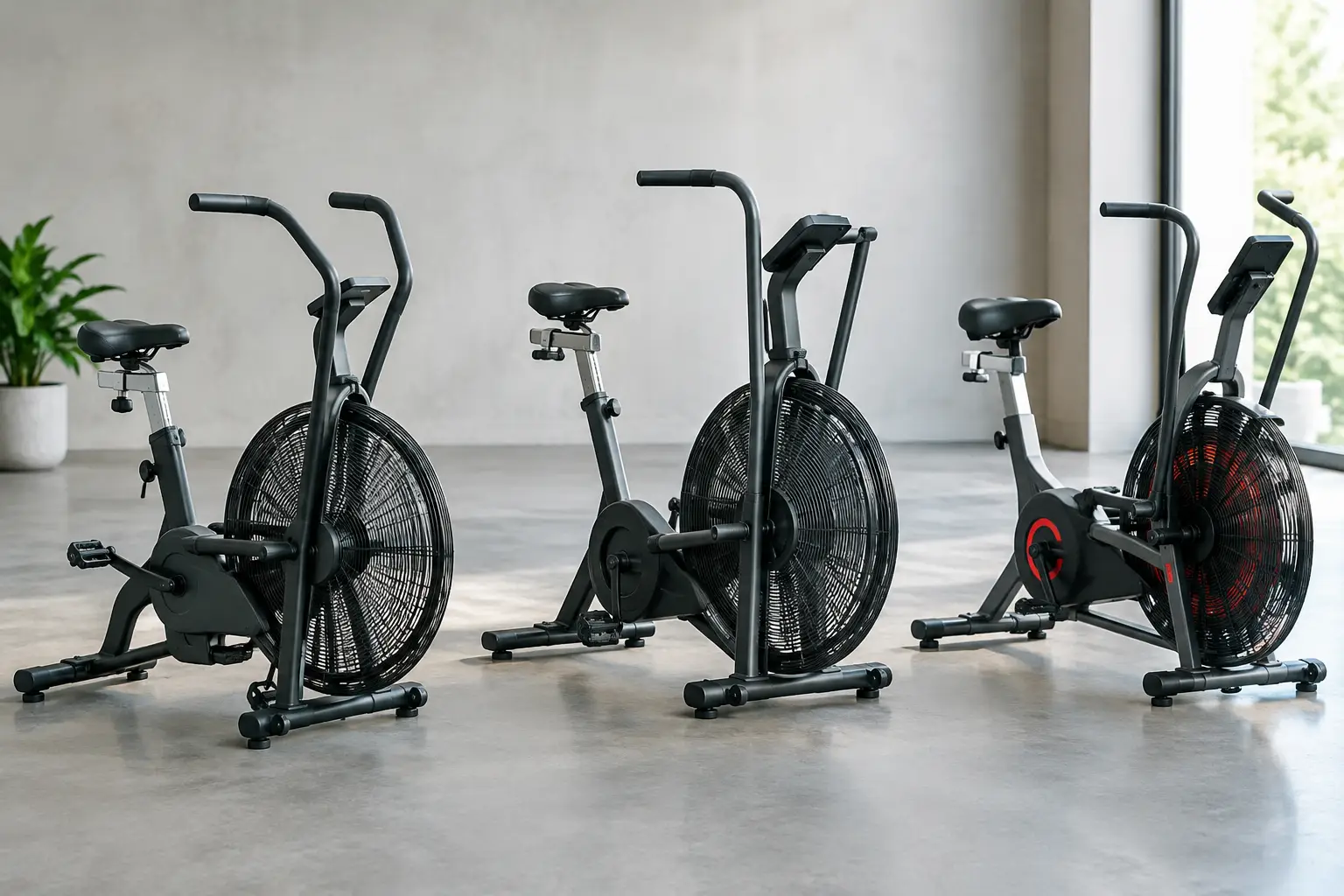
A hard 10-minute interval can make an air bike feel like the most demanding machine in a commercial gym. At home, though, the best choice is not automatically the biggest fan, the highest price, or the model an elite athlete uses. This air bike comparison focuses on what changes your day-to-day experience: how the bike feels under effort, how much room it takes, how it handles repeat use, and whether its features match the way you actually plan to train.
Air bikes use a large fan to create resistance. Pedal and push or pull the moving handles harder, and resistance rises immediately. That simple design makes them useful for short conditioning sessions, warmups, full-body cardio, and low-impact workouts that still challenge your lungs and legs. It also means two bikes that look similar on a product page can feel noticeably different in your space.
Air Bike Comparison: Start With Your Training Style
Before comparing frame specs or display screens, decide what role the bike will play in your home gym. A beginner who wants three comfortable cardio sessions each week does not need the same machine as a lifter adding short finishers after strength training. Someone preparing for fitness races, CrossFit-style workouts, or hard intervals may benefit from a heavier-duty platform and more precise workout tracking.
For general fitness, look for a stable bike with a comfortable seat, intuitive controls, and a display that shows time, distance, calories, and speed. These basics are enough to structure intervals and see progress without paying for features you will never use.
For high-intensity training, prioritize a strong frame, a high stated user weight capacity, durable pedals and crank components, and a console that supports interval programming. Repeated all-out efforts place more stress on the bike than steady pedaling. A budget model can still work, but it may shift, rattle, or require more frequent adjustments when used this way.
If low-impact exercise is the main goal, do not confuse low impact with low effort. Air bikes are easier on the joints than running, but the resistance can climb quickly. A bike with easy seat adjustments and a predictable riding position will matter more than advanced performance metrics.
What Actually Separates One Air Bike From Another
Fan resistance and riding feel
Most air bikes use fan resistance, but fan size, blade shape, drive system, and frame design affect the sensation. Larger fans often create more airflow and a stronger response during hard efforts. That does not make every large-fan bike better. The question is whether the bike responds smoothly at moderate pace and stays planted when you sprint.
Because fan resistance is self-regulating, there is no fixed resistance level to select like there is on a magnetic exercise bike. Your output determines the challenge. This is excellent for intervals and shared households because a beginner and an advanced exerciser can use the same machine without changing a resistance knob.
Some models pair the fan with extra air-control settings or magnetic resistance. Those options can add structure for steady training, but they also add cost and complexity. Choose them if you want more control over easy and moderate rides. If your main goal is simple, hard conditioning, a standard fan system is usually enough.
Belt drive versus chain drive
The drive system is one of the most useful details in an air bike comparison. Belt-driven bikes typically run more quietly and need less regular maintenance. They are a practical choice for apartments, early-morning workouts, or shared spaces where mechanical noise would be distracting.
Chain-driven models often have a more traditional gym-bike feel and can be very durable, but they may produce more noise and need periodic lubrication or tension checks. Neither system is automatically superior. A well-built chain bike can outlast a poorly built belt bike. Still, a belt drive is usually the easier recommendation for a home buyer who wants minimal upkeep.
Keep expectations realistic about sound. The fan itself moves a lot of air, especially during sprints. Even a quiet belt-driven air bike is not silent. It is more like a strong box fan than a whisper-quiet magnetic bike.
Frame stability and footprint
An air bike needs a stable base because it is designed for forceful full-body movement. Check the product footprint, then add clearance around the front and sides for the handles, your knees, and airflow. A bike that measures roughly 50 to 60 inches long can fit in many home gyms, but a tight corner may make mounting, dismounting, and cleaning frustrating.
Pay attention to the bike's weight as well. A heavier unit is not always more durable, but weight often helps prevent rocking during explosive efforts. Front transport wheels are helpful, especially if the bike will share space with a rack, bench, or storage system. Just remember that rolling it away does not eliminate the need for a dedicated workout zone while you ride.
Place the bike on level flooring. A dense equipment mat can reduce vibration, protect floors, and make cleanup easier. It will not turn a loud fan into a quiet one, but it can reduce the transfer of noise to the room below.
Adjustability and comfort
Most air bikes allow vertical and horizontal seat adjustments. This may sound basic, but it determines whether your knees, hips, and shoulders feel comfortable after several sessions. Ideally, you should be able to reach the pedals with a slight bend in your knee at the bottom of the stroke, without sliding forward on the saddle or overreaching for the handles.
Taller or shorter riders should look closely at the stated fit range and customer feedback about inseam compatibility. If multiple people will use the bike, choose one with adjustment points that are quick to understand and firmly lock into place.
Handle design matters too. Some grips offer multiple hand positions, while others are simpler and more compact. Multiple grips are useful for longer sessions because they let you change wrist and shoulder angles. For short intervals, nearly any comfortable, non-slip handle design can work well.
Console and workout feedback
A basic console is not a deal-breaker, but poor data can make training less satisfying. At minimum, look for clear readings for time, distance, speed or RPM, and calories. A backlit display is worthwhile if your home gym has dim lighting.
More capable consoles may track watts, heart rate, interval targets, and repeatable workout programs. Watts are especially helpful if you want to measure effort from session to session. They give you a clearer target than vague cues like “go hard.”
Do not pay extra for app compatibility unless you know you will use it. Many home exercisers get more value from a visible timer and a simple written plan than from another subscription or connected platform. Reliable buttons and readable numbers beat an elaborate screen that sits unused.
Compare Price Against the Parts That Wear
Air bike prices can vary widely, so focus on build quality rather than brand name alone. The parts most likely to reveal a low-cost compromise are the pedals, cranks, seat adjustment post, bearings, console buttons, and drive system. Look for a clear warranty, replacement-part availability, and a manufacturer with a track record of supporting its equipment.
A lower-priced air bike can be a smart buy when it will be used for casual cardio a few times each week. Spending more makes sense when the bike will become your primary conditioning tool, when several household members will use it, or when you expect frequent sprint intervals. Buying too little bike can lead to unwanted wobble and repairs. Buying a competition-grade machine for occasional five-minute warmups can be just as wasteful.
Also budget for delivery and assembly. Air bikes are awkward rather than complicated, and some arrive partially assembled. Review the assembled dimensions, package weight, and doorway clearance before it reaches your home. That small bit of planning prevents a large box from becoming a hallway problem.
A Simple Way to Narrow Your Choices
Compare two or three bikes side by side using the same priorities: footprint, drive type, user weight capacity, seat range, console data, warranty, and total delivered cost. Then rank those details based on your routine rather than treating every feature as equal.
For example, an apartment exerciser may place compact storage and belt-drive noise first. A garage-gym lifter may value stability and interval metrics. A household with different riders may put seat adjustability and easy console controls at the top. The right model is the one that removes friction from the workouts you are likely to repeat.
Choose an air bike that fits your floor, your budget, and your real training habits, then give it a permanent spot where getting on for 15 minutes feels easier than making an excuse.