Picture this: a compact garage, a barbell, and the question of whether a bulky cage will fit without blocking the door.
When you begin planning a home gym the choice between a power rack vs squat rack is one of the earliest—and most consequential—decisions. You want safety and versatility, but you also have to worry about ceiling height, floor footprint, intended lifts and whether you’ll be training alone. This article tells you which rack fits which real-life setup and why, so you can pick the rack that matches your space and training style.
Decision criteria: the five things that should determine your choice
- Available floor footprint and ceiling height — measure the usable space, not the garage’s overall size.
- Primary lifts and training style — heavy singles with safety needs versus straightforward squats and presses.
- Need for built-in safety — spotter arms, safety pins, or full cage protection for solo lifting.
- Attachment and storage needs — pull-up bars, cable systems, plate storage and bands anchor points.
- Budget and long-term flexibility — initial cost, space to expand, and resale value.
Quick answer up front
If you need maximum safety, versatility and room for attachments, choose a power rack (power cage). If you have a tight footprint, limited ceiling height, train mainly with lighter loads or have a training partner to spot you, a squat rack (including half-rack or rack stands) is probably the better fit.
How space and ceiling height change the trade-off
Power racks are typically taller (80–90"+) and deeper (36–48"+) because they enclose the bar path with four uprights. That extra depth and height is what allows full-length safety pins, integrated pull-up bars and cable attachments. If you have a standard 8-foot ceiling, measure clearance for a standing athlete plus the pull-up bar—heads meet pull-up bars faster than you expect.
Squat racks (including half racks or independent stands) usually occupy less depth—often 24–36"—and are shorter in profile. They can fit against a wall and in lower-ceiling rooms. If floor footprint is the limiting factor, a squat rack will let you keep walkways and door access clear.

Safety and training alone: why a power rack excels
For lifters who train alone and plan to lift heavy (near-maximal singles or heavy doubles), a power rack’s full-length safeties or adjustable safety pins are non-negotiable. They allow you to set a physical stop so a failed lift won’t crush you. Many power racks also include boltable spotter arms for dynamic movements and plate catchers for clean drops.
Squat racks can be fitted with spotter arms, but they’re often shorter or less robust than a full cage’s safeties. If you rely on a training partner to spot every heavy set, a squat rack is reasonable—but understand the trade-off when you inevitably want to train alone.
Versatility and attachments: what each rack lets you add
Power racks are modular: lat pulldowns, cable crossovers, landmine attachments, dip bars and multi-grip pull-up bars are common add-ons. If you want a one-stop strength station to cover squats, presses, rows, pull-ups and cable work, the power rack is the better long-term platform.
Squat racks are simpler. Some half-racks offer pull-up crossbeams and band pegs, and many racks include storage pegs for plates to keep a small space tidy. For many lifters who focus on barbell basic lifts and have limited space, a squat rack plus a bench and a simple standalone cable option will cover 80% of training needs.
Budget, build, and resale considerations
Power racks typically cost more because of additional steel, hardware and optional accessories. But they also hold resale value better for serious lifters. If budget is tight and your main lifts are squat and bench with a partner available, a squat rack gives the best price-to-function ratio.
Who should pick a power rack
- You train alone frequently and lift heavy—safety pins are essential.
- You want a multi-function station with pull-up, cable or lat attachments.
- You have at least a 36–48" deep area and ceiling clearance above 84 inches.
- You plan to keep the rack long-term or make it the gym’s central piece.
Who should pick a squat rack (or half-rack)
- Your space is compact (narrow room, low ceilings) and you need a smaller footprint.
- You train mainly with moderate loads or have a reliable training partner.
- You want a more affordable setup and don’t need extensive attachments.
- You prioritize an easy-to-move or reconfigure rack in a multi-use room.
Product recommendation for typical home setups
If you decide on a full power rack, consider a high-ranked option that balances load capacity and accessory compatibility. For many home users the GXMMAT G5 Power Rack is a strong fit: it offers full safety, built-in pull-up capability, and plate storage for a typical garage gym.

If space is the overriding constraint and you want something compact but sturdy, a well-rated half-rack or simple squat stand is appropriate—look for models that include detachable spotter arms and plate storage to maximize utility in a small footprint.
Installation and placement checklist before you buy
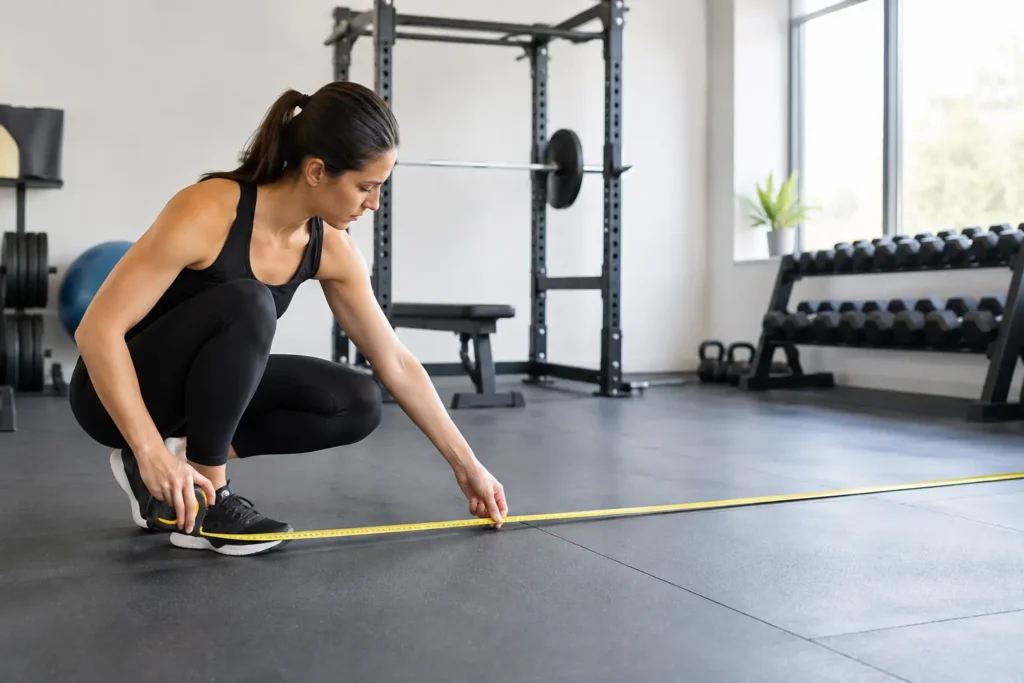
Before ordering, measure these clearances: front-to-back depth including bar and lifter, ceiling height plus pull-up bar clearance, doorways and path for delivering the rack, and where plates will be stored so they don’t block movement. Confirm floor strength—concrete or gym mat recommended—and whether you need to bolt the rack to the floor for stability.
[hints: link to related guide]Need a quick reality check on space? See How Much Space Do You Really Need for a Home Gym? for measuring tips and layout examples.
Small but important details people often miss
- Barbell overhang: when racked, the barbell adds a few extra inches on each side that matter in narrow rooms.
- Door swing and storage: a rack near an entry can block a door if placed too close—visualize the room with tape on the floor.
- Floor protection and noise: full racks with plate storage concentrate weight—use thick mats to protect subflooring and reduce noise for shared walls.
Final comparison at a glance
- Safety: power rack wins for solo heavy lifting.
- Space efficiency: squat rack wins for tight footprints and low ceilings.
- Versatility: power rack wins for attachments and future upgrades.
- Cost: squat rack wins for lower initial outlay.
Choosing between a power rack vs squat rack comes down to honest measurement and matching the rack to the way you train. If safety and expansion matter most and you have the space, go power rack. If footprint, budget and a partner spotting you are the constraints, a squat rack will serve you well.
- Measure ceiling height, floor footprint and door clearance in the planned spot.
- Decide whether you’ll train alone or need built-in safety pins.
- List must-have attachments (pull-up bar, lat pulley, plate storage).
- Confirm floor can be protected or bolted if necessary.
- Compare top-ranked models for weight capacity and included safeties.
If you have room and lift heavy by yourself, choose a power rack for safety and future upgrades. If space or ceiling height limits you, a squat rack or half-rack gives compact, lower-cost utility—pair it with good planning and a spotter for heavy sets.
Can a power rack fit in an 8-foot ceiling garage?
Maybe—measure carefully. Many power racks approach 84–90" tall including pull-up bars, so you may need a short-profile model or remove the pull-up bar to fit under an 8-foot ceiling.
Is a squat rack safe for heavy singles?
Only if outfitted with robust spotter arms or if you always have a trained spotter. For solo near-max lifts, a power rack is safer.
Do I need to bolt a rack to the floor?
Not always, but bolting improves stability for dynamic lifts and high loads; a heavy-duty rack on a solid floor with anti-slip mats may be sufficient for many home users.
Which rack holds more attachments?
Power racks typically offer the most attachment options—lat pulldowns, cable crossovers, dip stations and more—because of their four-post design and extra clearance.
What’s the easiest way to check fit before buying?
Use painter’s tape to outline the rack footprint on your floor and stand under the intended pull-up bar height to simulate actual use—this reveals real conflicts fast.